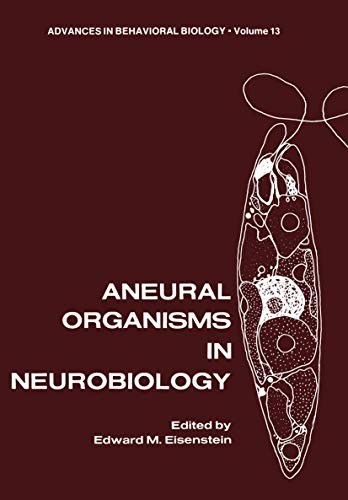

This volume had its inception at a symposium entitled Aneura1 Organisms: Their Significance for Neurobiology held at the Winter Conference on Brain Research in Vail, Colorado, in January, 1972. The original participants were Drs. Epstein, Hamilton, Kung, Wood and myself. However, since that time several other authors (Drs. Applewhite, Chen, Diehn and Ettienne) were asked to contri- bute papers and all were asked to update their presentations so as to present a broad perspective as to the role and significance of aneura1 systems for investigating neurobiological problems. This volume is the result of that effort. I wish to thank Dr. Claude F. Baxter, the program chairman of the Winter Conference, and his staff for their help, as well as the contributors for their efforts. Great appreciation is due Mrs. Sharon Loomis for her excellent work in preparing the manuscript for publication. It is our hope that this volume will demonstrate the usefulness and advantages in exploiting aneura1 systems for the insights they may yield in answering some of the fundamental neurobiological questions facing us. E.M. Eisenstein v Contents Aneural Systems and Neurobiology: A Point of View . * . 1 E.M. Eisenstein (Introduction) Protozoa as Models of Stimulus Transduction 5 David C. Wood Genetic Dissection - An Approach to Neurobiology 25 Ching Kung Cybernetics and the Behavior of Microorganisms 41 Bodo Diehn Control of Ciliary Activity in Aneural Organisms 59 Miles Epstein Membrane Potential and Behavior: Proposal of a Model System * . . . . . . . .
 Kids will love this hilarious fairy tale adventure packed with clever twists, familiar characters and page-turning fun.
 The second book in a fabulous new magical, middle-grade series filled with adventure, wonder and wildness,
This is Book 13 in the Advances in Behavioral Biology Series. See all Advances in Behavioral Biology books here.
No one has written a review for 'Aneural Organisms in Neurobiology'
Why not be the first to share your opinion?