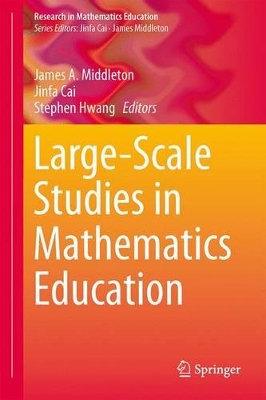

In recent years, funding agencies like the Institute of Educational Sciences and the National Science Foundation have increasingly emphasized large-scale studies with experimental and quasi-experimental designs looking for 'objective truths'. Educational researchers have recently begun to use large-scale studies to understand what really works, from developing interventions, to validation studies of the intervention, and then to efficacy studies and the final "scale-up" for large implementation of an intervention. Moreover, modeling student learning developmentally, taking into account cohort factors, issues of socioeconomics, local political context and the presence or absence of interventions requires the use of large data sets, wherein these variables can be sampled adequately and inferences made. Inroads in quantitative methods have been made in the psychometric and sociometric literatures, but these methods are not yet common knowledge in the mathematics education community. In fact, currently there is no volume devoted to discussion of issues related to large-scale studies and to report findings from them. This volume is unique as it directly discusses methodological issue in large-scale studies and reports empirical data from large-scale studies.
 Kids will love this hilarious fairy tale adventure packed with clever twists, familiar characters and page-turning fun.
 The second book in a fabulous new magical, middle-grade series filled with adventure, wonder and wildness,
This is Book 9 in the Research in Mathematics Education Series. See all Research in Mathematics Education books here.
See More Educational: Mathematics & numeracy
No one has written a review for 'Large-Scale Studies in Mathematics Education'
Why not be the first to share your opinion?